Some people plan a trip having heard that “Okinawa celebrates the Lunar New Year.” The reality is a little more layered.
Most of the main island keeps the new (solar) year
As daily life shifted to the solar calendar, most areas of Okinawa’s main island came to celebrate the January 1st New Year.
So on the day of the Lunar New Year, the streets of Naha are as usual. Shops are open, and transport runs normally. There is none of the “the town stops” effect of Obon.
You don’t need to rework your plans.
Where the Lunar New Year remains strong
In some places, the Lunar New Year is still kept as the true New Year. The clearest example is fishing towns such as Itoman.
Fishing depends on the tides, and the tides are set by the moon. Because the lunar calendar was the calendar of the work itself, the old observances remained strong in fishing towns.
The fishing-boat flags at Itoman
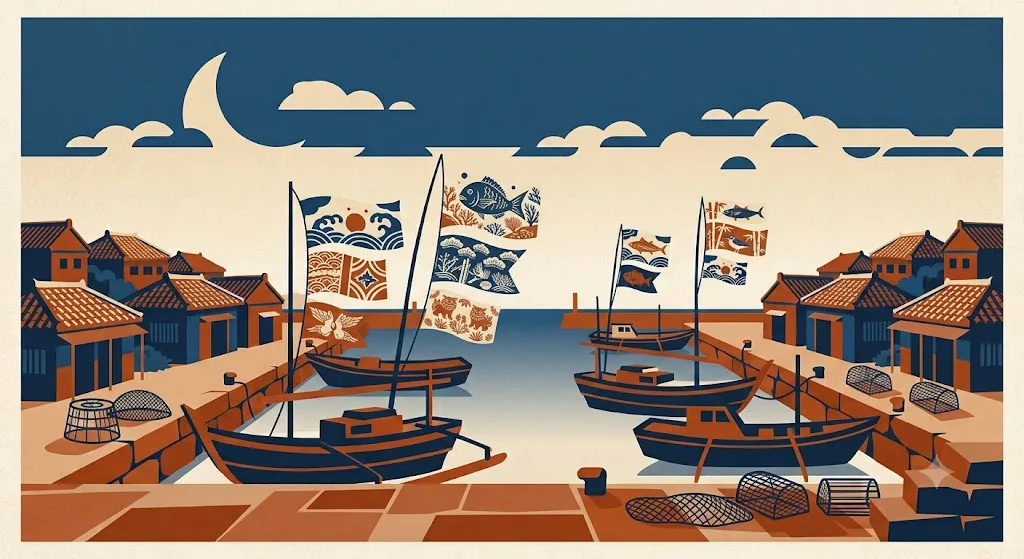
On the morning of the Lunar New Year, Itoman’s harbor fills with boats flying great catch flags (tairyō-bata). They pray for a year of safe voyages and good catches, and the sight of the colorful flags streaming in the wind belongs to this day alone.
Some people come to watch. View it from where you won’t get in the way of the harbor’s work. You may also see people visiting Hakugin-dō, the shrine to the sea god.
Elsewhere, some communities — such as Kudaka Island and parts of the north — hold observances on the Lunar New Year too.
It can fall on a different day than the Chinese New Year
This is the point this site watches most closely.
The Lunar New Year is the 1st day of the 1st lunar month — that is, the day of the new moon. But depending on which standard time you measure the instant of the new moon by, the date can differ by a day.
Japan’s lunar calendar uses Japan Standard Time; China’s uses China Standard Time. For example:
| Year | Lunar New Year in Japan | Chinese New Year |
|---|---|---|
| 2027 | Feb 7 | Feb 6 |
If a date you found by searching “Chinese New Year” disagrees with Okinawa’s Lunar New Year, this is why.
The dates on this site are computed on Japan Standard Time and checked against the almanac (Rekiyō) published by the National Astronomical Observatory of Japan.
The Lunar New Year is only the beginning of the new-year season
Okinawa’s lunar new-year observances do not end with New Year’s Day.
- The Lunar New Year (1st of the 1st lunar month) — the New Year of the living
- The Jūrukunichī (16th of the 1st lunar month) — the New Year of the afterworld. In Miyako and Yaeyama many people return home, so flights and ferries to those islands are crowded then
- The Twentieth-Day New Year (20th of the 1st lunar month) — the close
In terms of the effect on travel, the Jūrukunichī deserves more caution: if you plan to use flights or ferries to Miyako or Ishigaki, book early.
This season in Okinawa
The Lunar New Year falls between late January and mid-February on the solar calendar.
- Around 15–20 °C. Too cool to swim; you’ll want a jacket
- The season of the kanhizakura cherry. It begins to bloom from late January at Yaedake in Motobu and elsewhere
- A quiet season for tourism, so lodging is easy to book