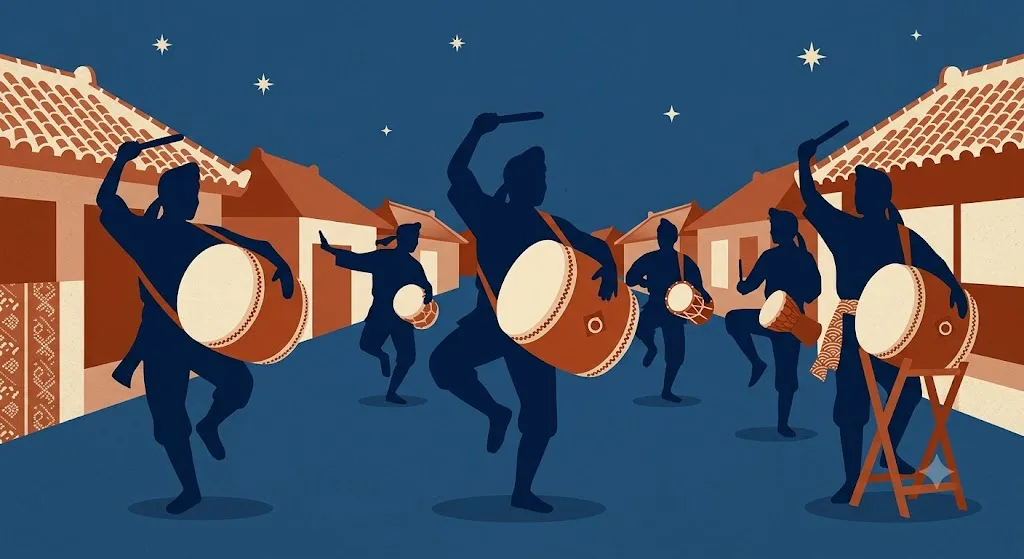
“I want to see eisā in Okinawa” — it is a common goal for a trip. But eisā is not something you can see anywhere, all year round.
There are three ways to encounter it.
1. The Obon street dance (michijunē) — eisā in its true form
Eisā began as a dance for welcoming and sending off ancestors at Obon. The michijunē, in which a youth association parades through its neighborhood, is its original form.
- When — the nights of Obon (the 13th–15th of the seventh lunar month). On the modern calendar this falls anywhere from early August to early September, depending on the year
- Where — the streets of each district, not a tourist venue
- Character — a community event, not a show for visitors
The drums draw near, and a procession passes through a dark street. There are no spectator seats; it happens where people live.
You may watch from the roadside, but don’t block the route, and don’t use flash. See Watching Okinawa’s Events for more.
In Okinawa City (Koza), several youth associations perform around the Goya intersection and Gate Street during Obon, which makes it relatively easy to watch.
2. Festival eisā — easy to plan around
These are large performances that welcome an audience. If you want to be sure of seeing eisā, go to one of these.
| Festival | When | Notes |
|---|---|---|
| The Okinawa Zentō Eisā Festival | a weekend once Obon is over (3 days) | the largest in the prefecture; youth associations from all over gather |
| The “10,000 Eisā Dancers” parade | the timing has been shifting | on Kokusai Street in Naha; you stand close to the dancers |
Neither is on a fixed date. The Zentō Eisā Festival moves with Obon, and the “10,000 Dancers” parade has recently shifted even its season (October in 2025).
The Zentō Eisā Festival is not always the weekend immediately after Obon — in some years a week falls in between. Don’t assume “late August” — check the dates for the year.
3. Year-round shows — see it any time
If you can’t travel during Obon, cultural facilities hold regular performances. Ryukyu Mura, Okinawa World and others stage eisā throughout the year.
They differ in character from the community event, but they let you see it regardless of season. Check each venue for times and current status.
Choosing by your travel dates
- Traveling in August–September → look up the Obon dates and aim for a michijunē or the Zentō Eisā Festival
- Any other time → a year-round show, or browse other events
The date of Obon moves by nearly a month from year to year. “Go in August for Obon and you’ll see eisā” is not a safe assumption. First check when Obon falls that year.
Worth knowing as you watch
An eisā troupe has defined roles.
- Ō-daiko / shime-daiko — the large and small drums; the dancers at the center
- Te-odori — the hand dancers, who carry no drum and dance with hands and body
- Jikata — the sanshin players and singers who carry the performance
- Chondarā — the white-painted clown who marshals the line and works the crowd
Costumes and styles differ from troupe to troupe. At a festival where associations perform one after another, the differences are easy to see.